


Civic Culture and the Architectural Self-Representation of a City
The Urban Bourgeoisie of Murcia
Murcia, a city in southern Spain, was founded in the ninth century by Abd al-Raḥmān II, the Arab ruler of what was then al-Andalus. Recognising the region’s exceptional agricultural potential, the Arabs introduced not only new crops but also innovative and highly advanced irrigation systems based on Arabic qanats – underground water channels locally known as galerías con espejuelos.
These measures proved remarkably successful. With the rise of the silk industry and – for the first time in Europe – the production of paper, Murcia experienced a period of economic and cultural flourishing. Following the Christian conquest of the city, Murcia went through alternating phases of prosperity and decline, while nineteenth-century Spain as a whole found itself in a particularly severe crisis. Overseas colonies fought for independence, while civil wars raged on the Iberian Peninsula itself between rival branches of the ruling dynasty.
The citizens of Murcia, however, were not critically dependent on the inflow of gold and silver from other continents. Their prosperity rested primarily on stable agriculture in the so-called “orchard of Europe” and on a thriving silk industry. These enabled members of the local bourgeoisie to accumulate wealth, pursue education, travel widely, and cultivate a refined taste for the arts. Quite naturally, they aspired to elevate the quality of their lives beyond the confines of provincial existence.
At the time, Britain represented the dominant cultural and social model, and everything was expected to be done “the English way.” Distinguished citizens of Murcia therefore looked to Britain for inspiration and decided to create their own version of English high-class clubs – known in England as gentlemen’s clubs.
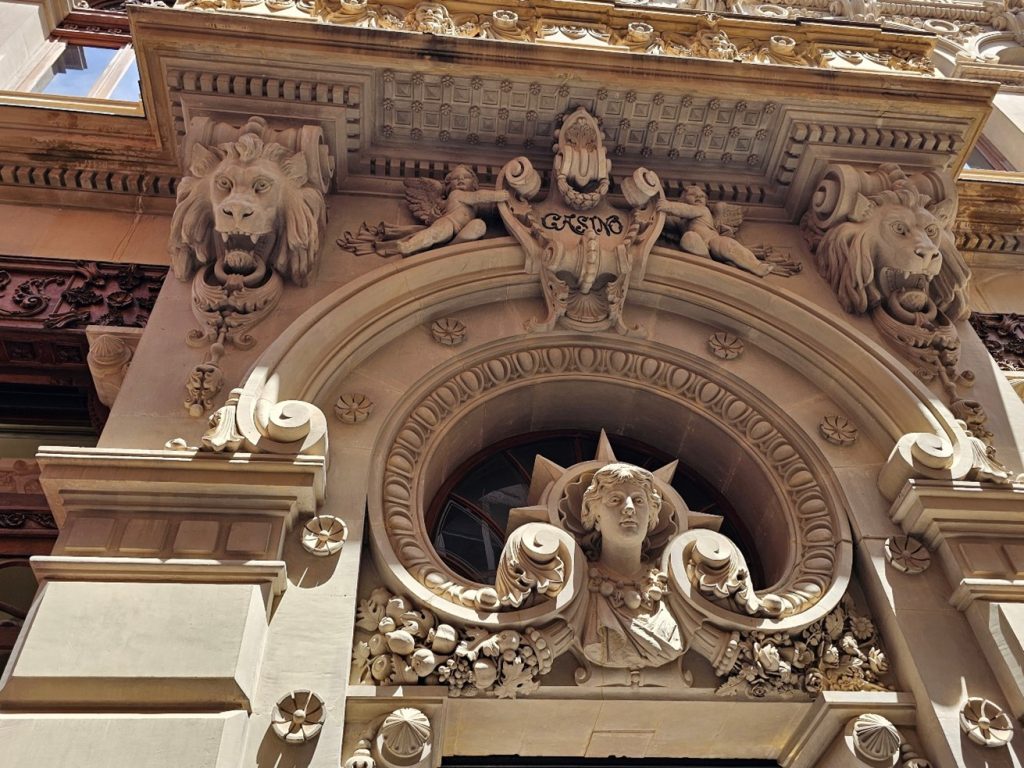
The Local Gentlemen’s Club – Casino de Murcia
This type of social association, referred to as a gentlemen’s club in England, is known in Spain as a casino cultural, despite having no direct connection with gambling. When members of Murcia’s liberal bourgeoisie founded their Casino on 11 June 1847, it was probably the first institution of its kind in Spain. The fashion spread rapidly, however, and by the end of the nineteenth century there were almost two thousand similar casinos throughout the country. Yet, the Casino de Murcia has remained unrivalled and is still regarded as the most beautiful among them.
The club members purchased a site near the city centre and commissioned several of Murcia’s most prominent architects to design different parts of the building. Each architect worked in his own manner, yet the brief deliberately emphasised diversity and the range of cultural influences as essential qualities the building was meant to express. Thus, between 1853 and 1902, an eclectic complex gradually took shape, as José Marín Baldo, Francisco Bolarín Jr., and Ramón Berenguer continued one another’s work in succession, drawing on their knowledge of the various architectural styles prevalent in Europe at the time. The ensemble acquired its final appearance in 1902, with the construction of the principal façade designed by Pedro Cerdán.
Access to the upper floor was reserved exclusively for club members. It houses the leisure rooms for the city’s gentlemen, where billiards, chess, and bridge are played, as well as mus – a form of Basque poker and probably the most widely played card game in Spain.
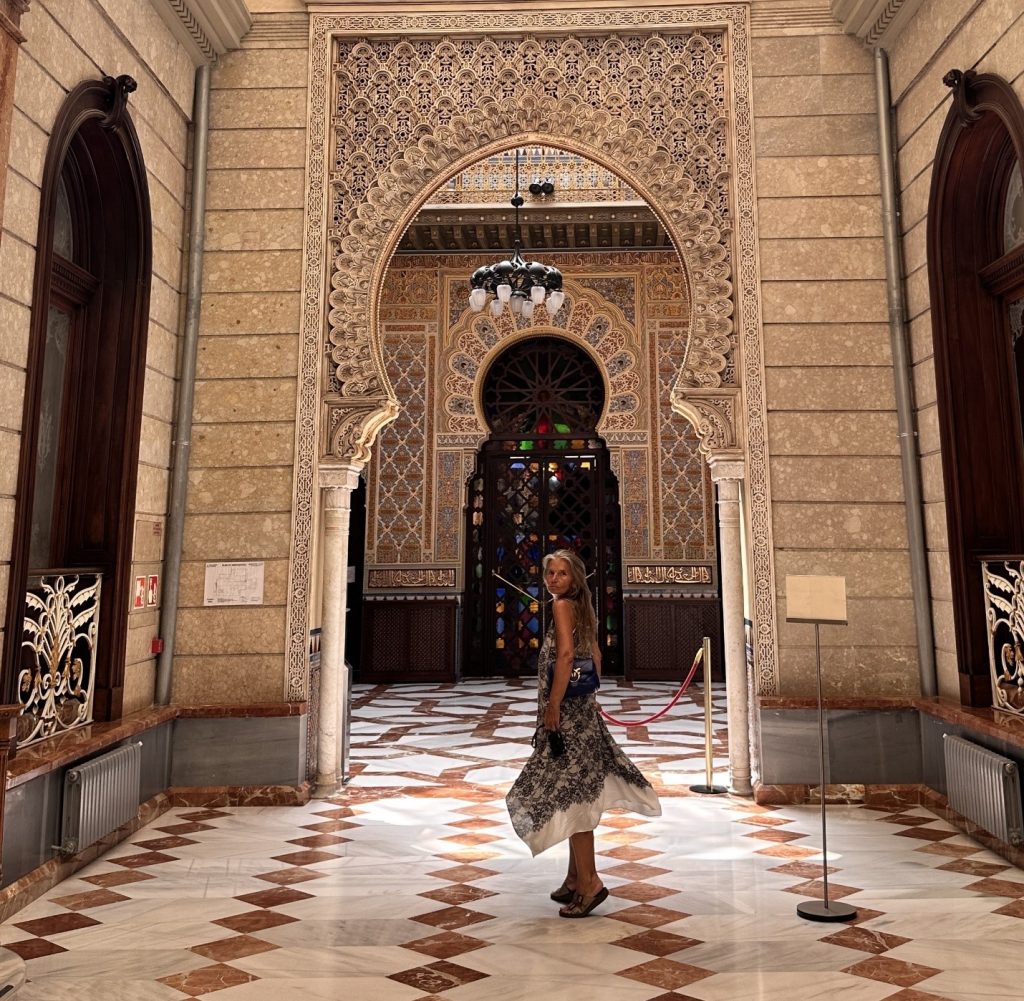
Today, the ground floor is open to visitors, and the Casino building ranks among the city’s most visited landmarks. All of its rooms are architecturally and decoratively engaging, yet the most striking among them are the Arab Courtyard, the English Library, the Ballroom, and the Pompeian Courtyard.
The Arab Courtyard
The decision by the club’s members – representatives of the liberal urban elite – to dedicate one of the central spaces to Arab culture deserves special praise. In doing so, they avoided narrow nationalist interpretations of the past and demonstrated a clear awareness that the Arabs were not only the founders of the city, but also bearers of the knowledge and skills that brought wealth, prosperity and renown to Murcia and, indirectly, to its elite.


The English Library
The English Library is the space that most faithfully embodies the founders’ original vision of the Casino: the creation of a club modelled on elite English institutions. It convincingly evokes the atmosphere of libraries found in comparable clubs and leading universities of the Victorian era. A dark wooden gallery A dark wooden gallery rests on finely carved, flamingo-shaped supports, while the ground floor houses a reading room furnished with exquisitely styled period furniture.
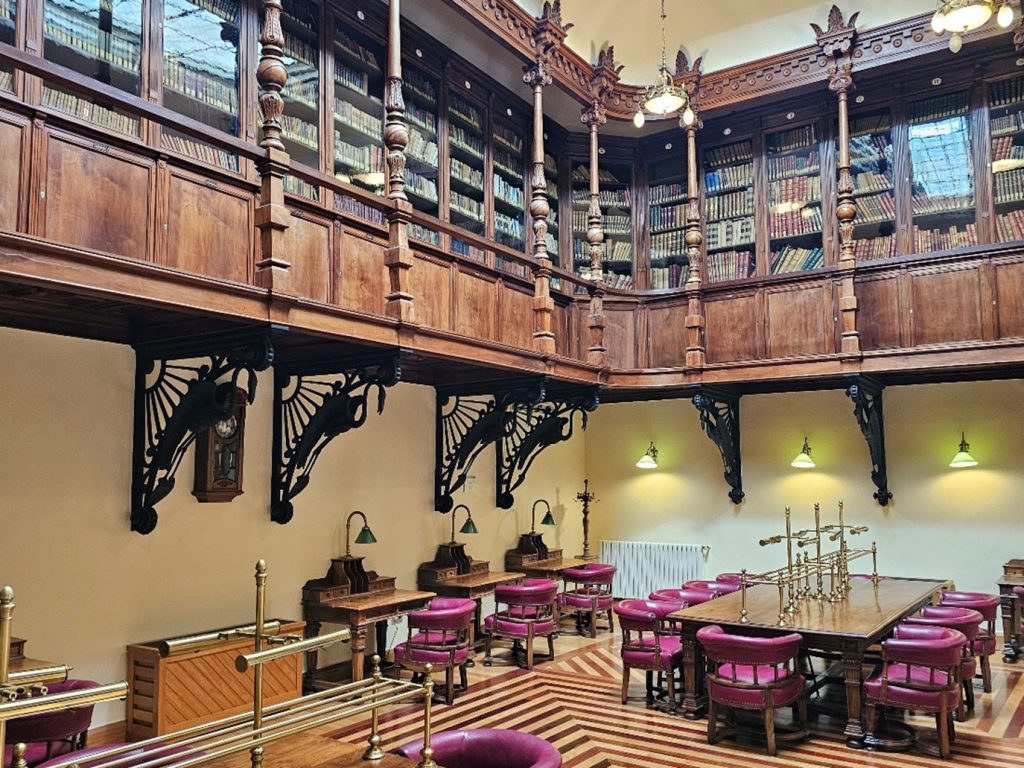
Who would not wish to spend a few quiet hours among twenty thousand volumes dating from the seventeenth, eighteenth, and nineteenth centuries? The library was completed in 1913, based on a design by the British firm Waring & Gillow.
The Ballroom and the Ladies’ Room
Although the Casino was initially intended exclusively for men, women were granted access relatively early. On that occasion, part of the former “Arms Hall,” which had served as a fencing hall, was converted into the so-called Ladies’ Room, equipped with numerous mirrors intended for grooming and preparation before social events.
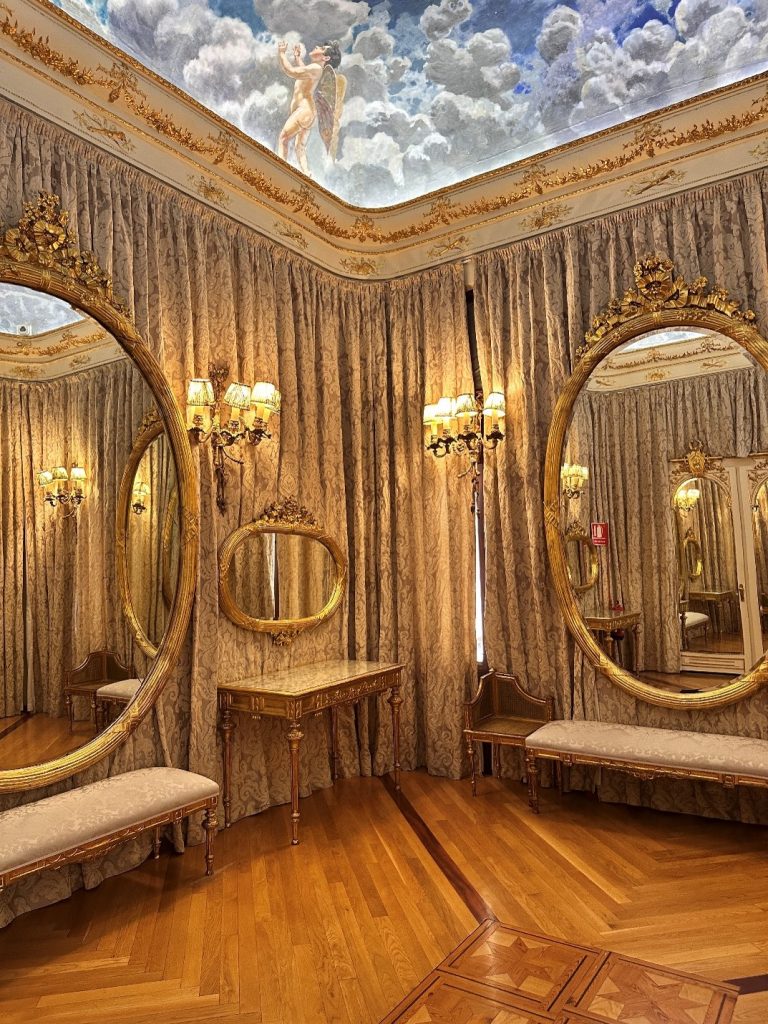
The true jewel of the Casino, however, is the ballroom, designed in the Neo-Baroque and Neo-Rococo styles. Visitors often feel as though they have stepped into a French royal court or imperial Saint Petersburg. The vaulted ceiling is painted in a lavish Baroque manner, depicting artistic disciplines alongside prominent members of the city’s elite of the time.
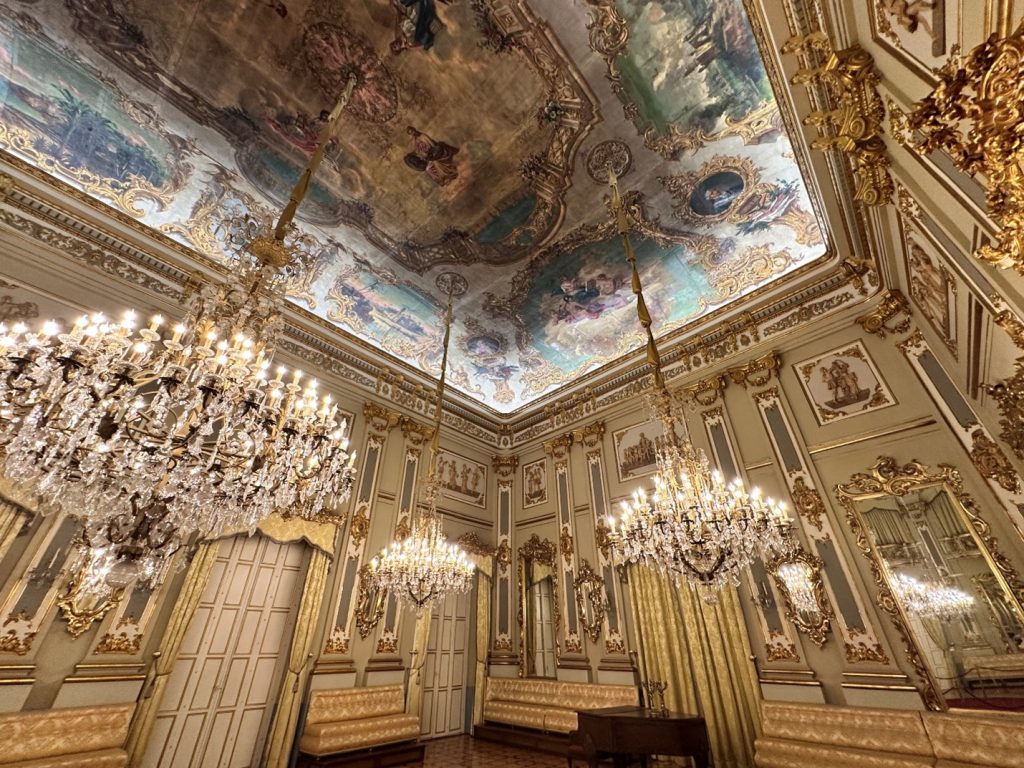
The gold and brass chandeliers that illuminate the hall originate from Miramare Castle in Trieste, once the residence of Archduke Maximilian of Habsburg. After appearing – somewhat unexpectedly – on the Paris art market, they were purchased by the Casino’s members and brought to Murcia. These were the city’s first electric chandeliers, which at the time posed a significant technical challenge. Despite numerous later restorations, the original wooden dance floor has been preserved to this day.
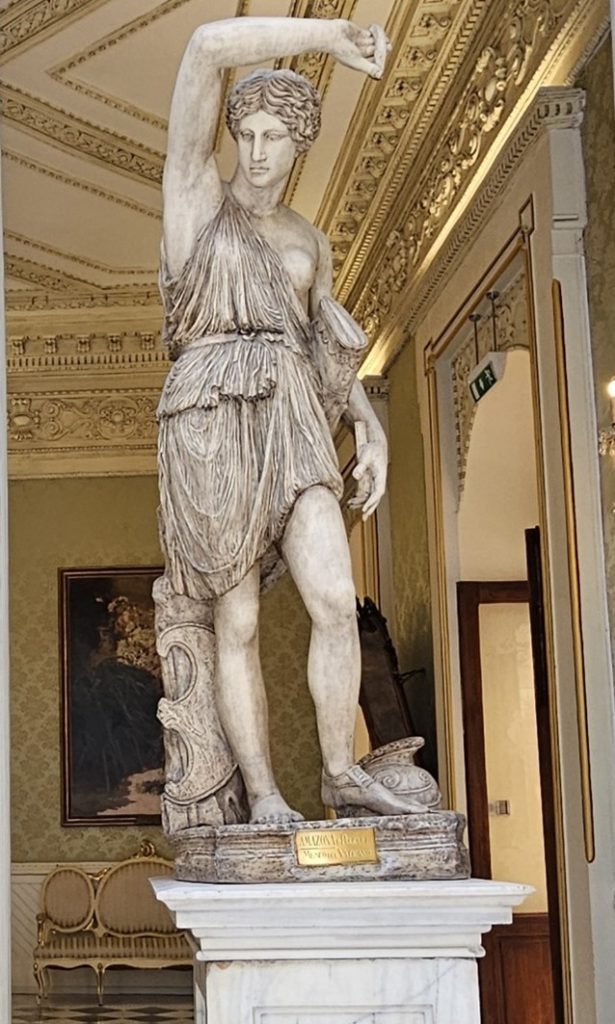
One space within the Casino stands out for its distinctive, almost elevated sense of calm: the Pompeian Courtyard. Covered by a glass vault and designed in a Neoclassical style, it contains several sculptures inspired by antiquity, including two faithful replicas of works by Polykleitos from the fifth century BCE, whose originals are housed in the Vatican Museums. The central position is occupied by a sculpture of Venus by José Planes.

The Successful Restoration of the Casino
From its very foundation, the Casino in Murcia served as a gathering place for lawyers, engineers, professors, artists, and other members of the liberal and secular urban elite. In politically unstable Spain, this role was not always easy to maintain, as ruling regimes often viewed educated and open-minded individuals with suspicion. Nevertheless, the Casino endured and has survived into the present day as the most beautiful and most complete example of a civic club of its kind in Spain.
In 1983, the Casino was declared a National Historic Building. Between 2006 and 2009, it underwent a comprehensive restoration, after which King Juan Carlos I granted the institution royal status. Since then, it has borne its full name: Real Casino de Murcia. Today, it has approximately 1,600 members, maintains its reputation, and continues to serve the community, occasionally organizing thematic exhibitions – most notably the one held in 2017 to mark the three-hundredth anniversary of the founding of the modern Masonic movement in England.
The Real Casino de Murcia is not merely an architectural monument, but a testament to a civic culture grounded in education, openness, and social exchange as the foundations of community life. Its eclecticism is not a sign of stylistic uncertainty, but a carefully considered expression of a cosmopolitan spirit: Arab heritage, classical antiquity, English restraint, and Baroque splendour converge here, united into a coherent whole that transcends individual eras and tastes. Could it be precisely this remarkable capacity to reconcile diverse traditions that enabled the Casino to outlast political shifts and ideological upheavals, while preserving its essential role?
Darko Veselinović, December 2025