


How the “Paris of the Caucasus” was built
The Oil Fever in Baku
Baku, the capital of Azerbaijan, is one of the most architecturally diverse cities in the world. Within its boundaries, one can encounter both a medieval Persian old town and hypermodern architectural fantasies. Yet the city’s most compelling layer lies in its central district, built in the years around the turn of the twentieth century. This part of Baku was conceived in accordance with the finest European architectural standards, enriched by the delicate infusion of distinctive local ornamentation. Parks and boulevards were laid out on the Parisian model, while office buildings and private residences pushed luxury to even greater heights. Immense capital was required, of course. But for some of the men behind these projects, the cost amounted to little more than pocket change.
The source of that wealth was oil. Nowhere in the world was oil so easily accessible as in Azerbaijan. It had always been used in this region in modest quantities — something even Marco Polo himself once observed. However, in the mid-nineteenth century, everything changed. Oil became the favoured fuel of the Industrial Revolution and the most sought-after commodity in the world. Within just a few years, a provincial backwater suddenly found itself at the epicentre of an oil boom. The pace accelerated even further in 1872, when the Russian imperial government, which then ruled Azerbaijan, liberalized the oil fields. Landowners were granted the right to sell their property to entrepreneurs and financiers, who would search for oil, extract it, refine it, and bring it to market. They all grew at least a little richer – some more than others – and a few got insanely rich.
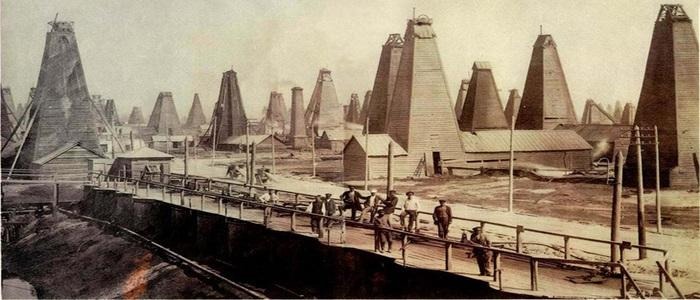
Early oil fields in the vicinity of Baku, circa 1900.
Today, it is difficult to grasp how rapidly the city transformed. By the end of the nineteenth century, hundreds of small refineries operated in the surrounding area. Around 1900, Baku alone produced roughly 50 percent of the world’s oil. Former peasants from nearby regions flooded into the city in search of work, joined by international financiers, engineers, and entrepreneurs. Baku soon became a cosmopolitan mosaic of Muslims and Christians, Easterners and Westerners, Armenians, Russians, Azerbaijanis, Jews, and Europeans – no single nationality forming a majority. Entrepreneurs – often foreigners from distant European lands – became the heroes of the age. The surnames of some of them remain known worldwide. The Nobel brothers, Ludwig and Robert, founders of the “Branobel” company, built the first modern refineries and launched the world’s first modern oil tanker, the “Zoroaster”. Alphonse de Rothschild introduced international financing, railway transport, and access to global markets. The price of such development, of course, was catastrophic pollution – but who cared? Greenhouse gases, climate change, the carbon footprint – none of this was yet part of human vocabulary. A few kilometres east of the affluent city neighbourhoods lay the so-called “Black City,” whose level of contamination made it resemble an alien wasteland. Yet this was a problem only for the workers. The wealthy elite resided in the city centre, in conditions that would have drawn envy even in the grand capitals of Europe.
Oil Barons and Polish Architects
Some of Baku’s oil magnates during its golden age did, in fact, hold noble titles. Among them were the local aristocrat Isa bey Hajinsky and Baron Peter von Bildering, with Bildering providing crucial early financing for the Nobel brothers’ venture. Alphonse de Rothschild, too, already bore the title of baron when he entered the Baku oil business. Most others, however, were Armenian and Azerbaijani entrepreneurs of modest origin. Once they accumulated vast wealth, the public swiftly dubbed them “oil barons.”
These newly enriched men – humble by birth and propelled almost overnight into staggering wealth – would seize the first opportunity to travel to Europe, returning brimming with impressions. Their desire to overcome centuries of backwardness was immense – and produced results. A thousand years of progress compressed into a single generation: from an illiterate mother in a hijab to a German governess and piano lessons for her daughter.
Naturally, they wanted their city to resemble what they had seen abroad – and their residences to surpass it, if possible. Such ambitions could not be realized without trained European architects and engineers, who recognized in Baku the opportunity of a lifetime. The most successful among them were Poles, and they would come to shape the city’s appearance.
The first Polish architect to establish a career in Baku was Józef Gosławski (1865–1904). When he arrived as a young architect, construction was underway on the Alexander Nevsky Cathedral, a project enthusiastically funded by the city’s Christians, Muslims, and Jews alike. The chief architect, Robert Marfeld, entrusted Gosławski with drawing the details. Completed in 1898, the cathedral stood until 1937, when Soviet authorities demolished it. Soon after its completion, Gosławski became chief architect of the city – precisely at the moment when Baku stood at its historical zenith. The position enabled him to design many of the city’s most important private and public buildings, including City Hall (1900–1904).
Baku, 2026. City Hall, architect Józef Gosławski
Among private patrons, his most significant client was Zeynal Taghiyev – a former bricklayer turned oil baron, who enjoys almost legendary status in present-day Baku. For Taghiyev, Gosławski designed a grand residence (now the State History Museum) and the Empress Alexandra Russian Muslim Boarding School for Girls, today an annex of the Academy of Sciences. Gosławski died young, yet his reputation and direct influence paved the way for other Polish architects to follow.
Baku, 2026. Typical Art Nouveau entrance doors from the early twentieth century
He was succeeded as chief city architect by his compatriot Kazimierz Skórewicz, who is most credited with the creation of the seaside promenade along the Caspian Sea – an element that still lends the city an added refinement. He also designed numerous luxury buildings, including corporate headquarters for both Rothschild and the Nobel brothers. After clashing with Russian authorities during the revolutionary turmoil of 1905, Skórewicz was briefly imprisoned and then expelled from Baku. He returned to Poland where he went on to build a successful career. His successor as chief architect of Baku was, once again, a Pole: Józef Płoszko.
Baku, 2026. Left: Ismailiyya, architect Józef Płoszko, built 1908–1913. Right: part of the Alexandra Empress Muslim Girls’ School, architect Józef Gosławski, built 1901
Płoszko excelled at integrating Islamic decorative motifs into impeccably designed buildings of Western functionality. His best-known work is the Ismailiyya building (1908–1913), commissioned by the oil baron Musa Naghiyev and today home to the Academy of Sciences. Another architect of Polish origin, Eugeniusz Skibinski, also left a significant mark on Baku. Born not in Poland but in Azerbaijan, he was naturally attuned to Oriental architecture from the outset of his career. Later, however, he adapted his style to suit the tastes of his most important client, the wealthy philanthropist Agabala Guliyev, an admirer of European architecture.
Baku, 2026. Typical façades in the city’s central district. All buildings feature façades in the warm tones of local limestone
Although Polish architects gave Baku much of its recognizable face, the cosmopolitan city offered ample opportunity for their colleagues from elsewhere. The 1898 urban master plan was largely the work of engineer Nikolaus von der Nonne, of German noble descent, while several major public buildings were designed by Armenian architects Gavril Ter-Mikelov (Gavriil Ter-Mikelyan) and Nikolai Bayev (Nikoghayos Bayev).
Baku, 2026. Mailov Theatre – detail. Architect: Nikolai Bayev. Built 1911
The Philanthropy of the Oil Barons
Today, the philanthropy of wealthy businessmen is most commonly associated with American magnates and their foundations through which they finance vaccination campaigns, education, humanitarian aid, democratic development, environmental protection, and similar initiatives for which states supposedly lack sufficient funds. In recent years, Bill Gates and Warren Buffett have been in the spotlight, but the standards were set more than a century ago by the most successful American businessmen of the time, Andrew Carnegie and John D. Rockefeller. Few people realize it, but that trend was in fact pioneered by Baku’s oil barons in the late nineteenth century. The immense fortunes they accumulated with startling speed did not lead them into gambling dens or narcotics. Instead, wealth afforded them the opportunity to support their community – yet, even that was not without obstacles.
One internationally renowned example is Alfred Nobel, a relative of the Nobel brothers and a shareholder in “Branobel”. Partly from his earnings there, he established the fund that awards what remains the world’s most prestigious prize, bearing his name and encouraging progress in science, medicine, and literature.
Baku, 2026. Bust of Zeynal Taghiyev on the façade of his residence in Baku, designed by Józef Gosławski.
Within Azerbaijan itself, Zeynal Taghiyev is even more revered. After amassing his fortune in oil, the former bricklayer financed numerous charitable initiatives. Consider the opposition he faced when he decided to build a school for Muslim girls in a religious environment that forbade female education, and within a Russian Empire deeply suspicious of its Muslim population. Nevertheless, Taghiyev remained undeterred. He invited several local mullahs and financed their journeys to leading Islamic theological centres – Cairo, Tehran, Istanbul – to consult higher authorities on whether the Qur’an prohibited women’s education. They returned with signed statements confirming that it did not. Local religious circles granted their consent. One obstacle remained: the Russian authorities. Taghiyev found a way in: he appealed to Empress Alexandra for support, promising to name the school after her. This was before she fell under the dark influence of the Siberian mystic Rasputin, and she gave her approval. The school opened in 1901.
When the Armenian oil magnate Daniel Mailov (Mailyan) decided to gift the city a theatre, he accepted a wager proposed by Taghiyev. Taghiyev believed a twelve-month construction deadline unrealistic – but if completed within that time, he would cover all expenses. The building was finished in just ten months. After an official inspection confirmed its completion, Taghiyev honoured his promise. Known historically as the Mailov Theatre, it is today the Azerbaijan State Academic Opera and Ballet Theatre. Currently under reconstruction – which will undoubtedly last longer than its original construction – the project already promises success.
Another oil magnate, Shamsi Asadullayev, financed the Western education of dozens of young Azerbaijanis. His friend Musa Naghiyev – whom urban legend paints as a miser – funded the Ismailiyya building, widely regarded as the most beautiful in the city, along with dozens of other structures. One wonders what he might have accomplished had he not been so “stingy.”
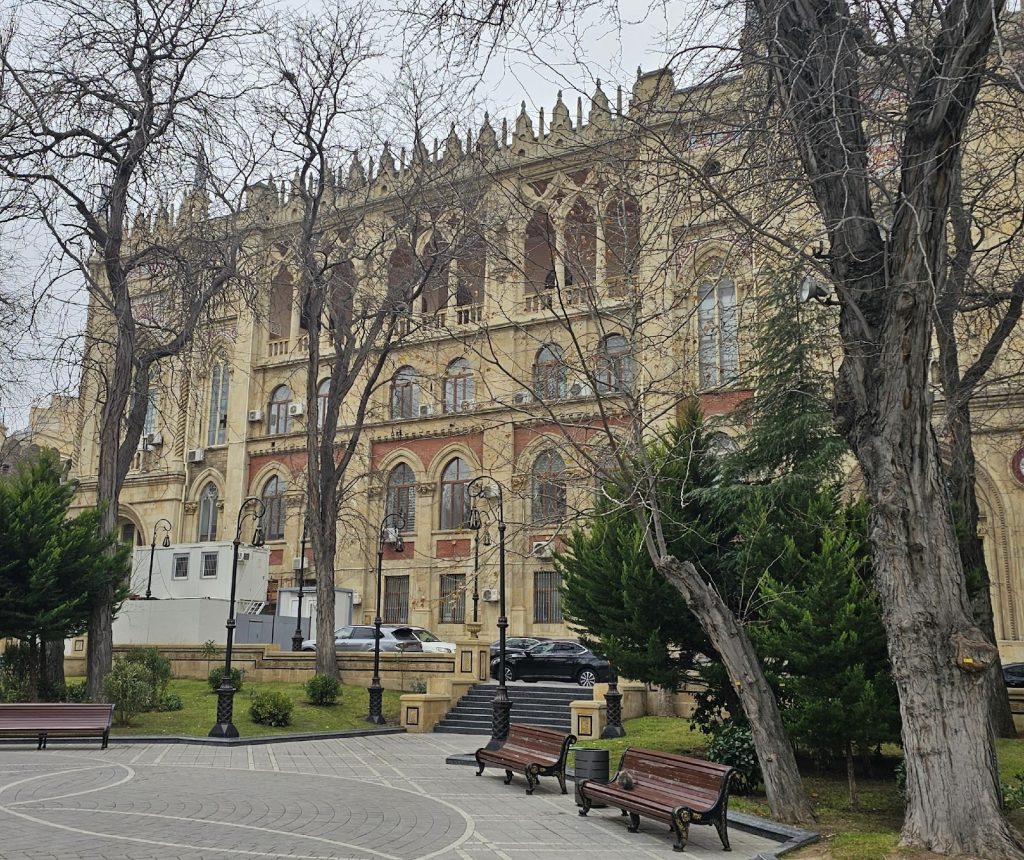
Baku, 2026. Ismailiyya – today the Academy of Sciences. Architect: Józef Płoszko. Built 1908–1913.
Everything seemed flawless. People of different nationalities and confessions collaborated on shared projects, building a common city with their shared wealth and financing charitable causes. Oil surges from the earth. Money keeps flowing. It should be spent – preferably on something useful. Or so it seemed.
Not everyone shared that view. After the Revolution of 1905, life in Baku grew far more complicated. As the Empire weakened, several groups sought to exploit the crisis, each driven by competing and violent ideologies. One such faction was organized by the bank robber and professional revolutionary Joseph Stalin, who arrived in Baku in 1907, shortly after the bloody bank robbery in Tiflis (present-day Tbilisi). In Baku, he formed a gang engaged in extortion, kidnappings, and robberies to finance his political party.
Another destabilizing force was the “Black Hundreds”, a Russian proto-fascist movement which, under the slogans “Orthodoxy, Autocracy, Nationalism” and “For Faith, Tsar, and Fatherland,” spread antisemitic propaganda and incited ethnic conflict between Armenians and Azerbaijanis. The gravest damage, however, was inflicted by Azerbaijani and Armenian nationalist organizations. Their clashes and the ensuing spiral of revenge led to alternating massacres – culminating in the massacre of Azerbaijanis in March 1918 and of Armenians in September of the same year. The historical memory of these events persists to this day; genuine reconciliation has never been achieved.
The Bolsheviks took control of the city in April 1920. Azerbaijan was incorporated into the Soviet Union, and the oil industry was nationalized. By that point, some of the prominent oil barons had already died, while their heirs had emigrated – most often to Paris – where, for as long as their savings allowed them to rent costly apartments, they felt almost at home. These events were later chronicled by Banine, by then an acclaimed French writer – the granddaughter of the philanthropist Shamsi Asadullayev and, through family ties, also of the “miser” Musa Naghiyev. The families of those oil barons who had not emigrated were expelled from their apartments and would spend the remainder of their lives reduced to humiliating conditions.
Even while the city’s ultimate political fate was still uncertain, oil fields and refineries were being bought and sold at speculative prices. The Nobel brothers sold their holdings to the American Standard Oil at well below market value, salvaging at least something before leaving Russia for good.
After nationalization, Baku’s oil industry was restored and modernized; production capacity even increased. But the golden age would never return. The buildings, boulevards, and parks left behind by the original oil baron–philanthropists remain today the pride of the nation – and the finest the city has to offer.
Darko Veselinović, February 2026